Monday 3rd September 2018 update
David Jacobs has a new must-read collection out called buzz:

https://www.redmoonpress.com/catalog/product_info.php?products_id=298&osCsid=681ac332970439bffbfc6c81e9eadd5a
review:
https://www.redmoonpress.com/catalog/product_reviews_info.php?products_id=298&reviews_id=14&osCsid=681ac332970439bffbfc6c81e9eadd5a
Thursday 25th January 2018
Update
The Book Depository is also a good place to seek out these books. Just click on the various currencies to see the price for you. If you are from another country, check out the box for multiple world currencies which is by the bright pink boxes upper right.
David Jacobs has a new must-read collection out called buzz:

https://www.redmoonpress.com/catalog/product_info.php?products_id=298&osCsid=681ac332970439bffbfc6c81e9eadd5a
review:
https://www.redmoonpress.com/catalog/product_reviews_info.php?products_id=298&reviews_id=14&osCsid=681ac332970439bffbfc6c81e9eadd5a
Thursday 25th January 2018
Update
Great to know that this book review is still working years later, where people are seeking the books out to buy!
For example, for Chad Lee Robinson's book:
And just click on the various currencies to see the price for you.
THE BOOK REVIEW
Themocracy: The Themocrats and their Concept Albums
Four book reviews by Alan Summers of writers who weave theme.
I was brought up in a time when music hit an exciting time for both children and young adults starting in the 1960s, with single songs, then big bands and their concept albums from The Who; The Beatles; Pink Floyd; The Kinks; Genesis, and then again with waves of wake up music in the early 1970s and the big wake up of Punk music in the mid to late 1970s. I bring that childhood and young adult excitement to new haiku collections, and in particular the new wave of short memorable collections coming in from America.
Being British, with this amazing outpour of British music hitting out internationally, I was not aware of American concept albums alas, but in haiku terms, the British haiku collection scene feels a little sleepy in general, and so I was excited, and fought to review British writer David Jacobs’ new collection amongst the new wave of American writers such as Chad Lee Robinson; Julie Warther; and Chase Gagnon (unbelievably only just turned twenty but with that new-grit voice I look for in haiku that echos the old and original concept albums, and we’ll see an even stronger haiku collection from him in time based on his tough times in Detroit).
There have been American concept albums, for instance Dolly Parton's 1973 My Tennessee Mountain Home, one of her most critically acclaimed albums, though not a commercial success, telling of her rural Appalachian childhood, culminating in the song "Down on Music Row", which details her move to Nashville at age 18. But it has to be Woody Guthrie and Dust Bowl Ballads (1940) that could be the first concept album, consisting exclusively of semi-autobiographical songs about the hardships of American migrant labourers during the 1930s from the point of view of a native of Oklahoma experiencing the life that migrant workers faced in California; and Merle Travis' Folk Songs of the Hills (1947) exclusively of songs about working life on railroads and coal mines in Kentucky.
So, theme, is it important, and why, and should it travel into haiku collections? The word theme C13 hails from Latin thema, from Greek: deposit, from tithenai to lay down, and is related to content, motif, motive, question, subject, matter, topic. I’ll attempt to look at theme, and its synomyms. To paraphrase Ernest Hemingway, slightly:
All good books are alike and after you finish reading one you feel it all belongs to you: The good and the bad,the ecstasy, the remorse and sorrow, the people and the places, and the flow of the seasons you didn’t know where out there, and in you too. If you can get so that you can give that to people, then you are a writer.
The four writers that’ll I look at are: Chad Lee Robinson (South Dakota, USA); David Jacobs (London, U.K.); Chase Gagnon (Detroit, Michigan USA); and Julie Warther (Dover, Ohio, USA).
Like The Who’s Quadrophenia, and much of Pete Townshend’s writing itself, its cathartic narrative engages and contains its own beauty: And such is the writing of Chase Gagnon and David Jacobs, whilst Julie Warther and Chad Lee Robinson have been partnered by the natural seasons, away from the complex narratives of the city, and in partnership with the life of rural cycles.

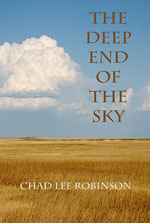
Chad Lee Robinson
46 pages of 47 haiku
Price: £8.30
Publishers: Turtle Light Press (2015)
ISBN-10: 097481475X
ISBN-13: 978-0974814759
For any clarification of a UK purchase re postage etc…
email: "Rick Black"
Or go here:
Or go here:
If you are from another country, check out the box for multiple world currencies which is by the bright pink boxes upper right.
“The Deep End of the Sky” is a Turtle Light Press Haiku Chapbook Contest Winner judged by Penny Harter. Chad Lee Robinson (b. 1980) is a seasoned award-winning writer who has been on the haiku scene for a very long time now, and continues to excite with his exactitude to place, both in geograpical birthplace, and on familial grounds. This is a writer of prowess, of sense of place and identity, and that’s very appealing to someone like me who often feels he has no anchor in polite society, but finds anchorage in writing like this, it’s vital to my well-being.
the Big Dipper –
rows of corn connect
farm to farm
my grandmother’s Bible–
every bookmark
an obituary
And I hear of an older brother who died tragically over a quarter of a century ago, on June 11, 1990:
my brother’s gravestone
under the moss a darkness
that won’t come off
One of the greatest strengths and sense of identity for haiku is the acknowledgment of seasons, real, actual, allegorically, culturally, and mythologically woven. This book is a four-part series exploring the seasons around South Dakota starting with The Tractor’s Radio, the title of the Spring section and contains 11 haiku. Robinson says:
“My family has deep roots in South Dakota. So, while many haiku in The Deep End of the Sky depict the farm landscape of America’s heartland, others are more personal, touching on aging and the loss of loved ones, such as this one…”
“My family has deep roots in South Dakota. So, while many haiku in The Deep End of the Sky depict the farm landscape of America’s heartland, others are more personal, touching on aging and the loss of loved ones, such as this one…”
spring rain—
speaking of the dead
in a softer voice
Rows of Corn is the second is the title of the summer section and features 11 haiku that focus on farm-related tasks and continues to explore familial relationships.
cemetery—
the scent of muskmelon
from the next hill
Farm Lights is the third section and the title of the autumn section. It gifts us with eleven haiku into the world of harvests; chores preparing for winter, and hunting, when October is the season:
sunset clouds
the decoy’ s touch-ups
in a different hue
And a time of apples and wine:
apple scent . . .
flecks of harvest dust
float in the wine
This section contains a haiku that was anthologised in Haiku in English: The First Hundred Years (W.W. Norton, 2013) as well as winning individual awards from The Heron’s Nest magazine, and The Haiku Foundation:
migrating geese —
the things we thought we needed
darken the garage
Home Early was originally called “Shiver”, and is the fourth section, which announces winter and includes fourteen haiku. Robinson says:
“It had 11 haiku in the original manuscript, but it was agreed upon that the collection would be stronger by making “Home Early” slightly longer to bring the reader out of winter, which can be long in South Dakota (I have seen snow as early as October and as late as May), and into spring, or at least hint at the coming of spring. As the section title suggests, many of the haiku found here are more introspective than in previous sections.”
“It had 11 haiku in the original manuscript, but it was agreed upon that the collection would be stronger by making “Home Early” slightly longer to bring the reader out of winter, which can be long in South Dakota (I have seen snow as early as October and as late as May), and into spring, or at least hint at the coming of spring. As the section title suggests, many of the haiku found here are more introspective than in previous sections.”
snow deepens–
the corner drawer full
of soup labels
hunter’s retreat
the Christmas tree made from
racks of antlers
This is perhaps the finest solo collection I’ve read in a decade, and I have witnessed some very fine collections over those years. It’s thematic layout and tone is rock steady and consistent in its interior and interactive motifs, and I feel I have almost lived in South Dakota during its four seasons, and grown all the more for that.
a farmer sets
the curve of his cap
prairie skyline


Julie Warther (Author), J S Graustein (Calligrapher)
Publisher: Folded Word (2015)
Paperback: 36 pages; 20 haiku
ISBN-10: 1610192222
ISBN-13: 978-1610192224
$8.00 US paperback
$0.99 US ebook
https://foldedchaps.wordpress.com/2015/03/23/what-was-here/
or
https://www.bookdepository.com/What-Was-Here-Julie-Warther-J-S-Graustein/9781610192224?ref=grid-view&qid=1516879742485&sr=1-1
or
https://www.bookdepository.com/What-Was-Here-Julie-Warther-J-S-Graustein/9781610192224?ref=grid-view&qid=1516879742485&sr=1-1
Julie Warther is another internationally recognized haiku poet, and serves as Midwest Regional Coordinator for the Haiku Society of America. She is a multi-award winning writer with her work anthologi sed including A New Resonance 9: Emerging Voices in English-Language Haiku (Red Moon Press 2015); Haiku 2014 (Modern Haiku Press) and The Red Moon Anthologies (2013-2015). There is an excitement in this book and it’s engendered by the seasons of Autumn and Winter, possibly two of the most iconic of seasons for haiku:
woodland trail
a notebook full
of blank pages
Warther captures the movement of the two seasons in and of themselves as well as the transitions of winter through, into, and around autumn:
this side of the pane
the wind nothing
but swaying treetops
whispers of winter
pass row by row
through the cornfield
As a man who remembers the boy in him, and the puzzlement, excitement, and awe of a first British winter in full snowscape: I remember opening our front door to find another door of snow and ice, three quarters up the frame in the smaller Winter of 1961-62. The big one, almost mythological in its dimension, and had me forever hooked on snow and Christmas, was of me walking thigh deep in snow, on my total own, no other children, not even adults around, on the way to Primary School, where I smashed my head on a carless road, which at least stopped me feeling cold as I plowed through fields of snow to get to the school in that bigger winter of 1962-63. Now I have a nose for snow:
sensing
before seeing…
overnight snow
But even Winter has to pass:
midday
the sound of sunlight
dripping from icicles
The seasons are still an adventure, despite my love of urban-bound haiku, and gendai which sometimes is the equivalent of Science Fiction warning us a year ahead, five, ten years ahead of where things might go wrong; and Warther shows us this excitement vital to our being. We forget what an impact a season can bring, and not just through natural history, or ‘nature’ but the games and festivities we build around them.
Both Chad Lee Robinson and Julie Warther bring that excitement of knowing the seasons, both the outdoor ones, and our internal ones as we grow older.

Chase Gagnon
Paperback: 24 pages; 37 haiku
Price: £4.93
Publisher: Mijikai Press (September 24, 2014)
ISBN-10: 1501072978
ISBN-13: 978-1501072970
See Amazon for purchase details
or
https://www.bookdepository.com/The-Sound-of-Shadows-Chase-Gagnon/9781501072970?ref=grid-view&qid=1516879785988&sr=1-1
or
https://www.bookdepository.com/The-Sound-of-Shadows-Chase-Gagnon/9781501072970?ref=grid-view&qid=1516879785988&sr=1-1
The Sound of Shadows is Chase Gagnon's first poetry chapbook and this writer, paraphrasing the blurb I gave the book
“…edges his work with atmospheremade larger by the storyteller’s gift. It could be said, paraphrasing Chase’s words, to be firefly ghosts in a frosted mason jar in moonlight. He is very much an up and coming writer creating excitement amongst writers and readers. His work is a breeze of shadows; a gypsy's finger-cymbals pinching the stars; but oh how slowly the fireflies disappear while he slides his lips across the harmonica."
“…edges his work with atmospheremade larger by the storyteller’s gift. It could be said, paraphrasing Chase’s words, to be firefly ghosts in a frosted mason jar in moonlight. He is very much an up and coming writer creating excitement amongst writers and readers. His work is a breeze of shadows; a gypsy's finger-cymbals pinching the stars; but oh how slowly the fireflies disappear while he slides his lips across the harmonica."
Chase Gagnon in his own words:
“My first attempts at the form were less than impressive, usually adhering to the classic 5/7/5 structure and using a lot of “filler” words. I wouldn't even consider what I was writing at that point haiku… I was discouraged at first, because I didn't think I'd ever be able to write like that, no matter how hard I tried. These little poems literally took my breath away, and being only fifteen years old, I was opening my eyes to a whole new way of seeing the world and I didn't quite understand that at the time.
The one poet who molded me into who I am today, and who I am becoming, is Alan Summers. He saw something in me that not a whole lot of other people did, and encouraged me to submit my poetry to haiku magazines, and always offered advice on how to improve my poems. Today, I'm 20 years old, and I have well over 100 haiku published and I have won a decent amount of awards.”
A bad early history of family homes burnt down, relocation, domestic abuse, and the ripples of violence that mark a family has honed this writer. Thankfully now, as he also fights depression, his mom is happily re-married (just recently) and the family have never been tighter, and his poetry from haiku, tanka, to haibun, and other forms cover a lifetime only just reached a score in years, with yet more to come:
no turning back
morning blushes
in our whispers
no one's footsteps
left to follow —
late winter rain
lonely night
I slide my lips
across the harmonica
desert motel...
darkness nestles
into an empty cow skull
graveyard raven
my shadow shackled
around my ankles
chilly dusk
the taste of dark chocolate
in her kiss
Deeply romantic, lyrical, brutally honest, always experiential even when Edgar Allan Poe drifts across, this is a young man’s journey out of hell, and halfway to somewhere better. This young man’s seasons, his themes of struggle, young love, and writing his way out of a bad life made good, made possible, by a strong and loving mom and family is one we can’t perhaps experience, but we can be honored by his stubborness to communicate with both himself and others like him, and that we too are included.

David Jacobs
Publisher: Hub Editions, Hub Haiku Series
Chapbook: 107 pages; 112 haiku
ISBN 978-0-9576460-4-9 Price: £6.50
The book is available to order from the author. He's a very nice to email, and even ask him to sign the book! :-)
To contact David Jacobs: davidjacobs2011@gmail.com
The book is available to order from the author. He's a very nice to email, and even ask him to sign the book! :-)
To contact David Jacobs: davidjacobs2011@gmail.com
David Jacobs is a born and bred Londoner whose work appears from Blithe Spirit to Modern Haiku, Acorn, Frogpond, Haiku Presence, Heron's Nest, Bottle Rockets, and many others. Jacobs’ work has also been selected by Red Moon Press for its best of the year anthologies, and received the British Haiku Award in 2011, plus receiving other prizes and commendations in haiku competitions.
This collection is a Magnum Opus with one hundred and twelve haiku, in comparison to the other three collections. Thankfully the power of its themes make this a wonderful read, and not at all bloated. These strong themes encompass other seasons, those outside nature, but of it too, such as our daily commute, thoughts of death (practical and otherwise) and one of the most powerful, endearing, and blisteringly powerful themes of today, that of mental health, as well as heartbreaking glimpses of a father and son relationship. They hold the book together, they are the stitches of multiple deep cuts that life rends from us. If you buy this book, buy it for the theme of son alone, or any one of the multiple themes. The book as whole is an amazingly woven work of lanes and roads making for a map of life. And if you can bear to read about depression, it’s worth it, as someone who has endured Black Dog all my life, and not knowing until a cafe owner in Hull switched a light on in my attic (metaphorically), and by accident has helped me deal with it.
This is an important book. It is not without its faults. I would have removed a number of haiku, and some that are flat statements, and those not quite close enough to the staunchly honest ripping away that senryu is. But keep at least one copy, or better still, two copies of this collection, one by the bedside, and one for sunlight, and when the light grows dim. The themes of the commute; depression; walking; walking without dogs; parents; death; visiting graves and cemetaries; trains; and his son are stunningly interwoven, showing great craft and care, in creating a collection that means something beyond the sum of its individual haiku. We are deeply privileged to be able to navigate the inner landscape of David Jacobs’ seasons, and it’s why experiential haiku at its most honest stands high on my list. We need these personal truths that some of us relate to, and be guided and comforted by, and grow by, and hopefully initiate hope in the dimming light. I’m also addicted, not just to personal accounts, biographical haiku, but the signature of poignancy, and the growing accounts of father and son are difficult to read without flinching, but when was haiku supposed to be pretty?
moon and stars
my son begins
to hold secrets
The skill of senryu, certainly the Western adaptation, and of others from outside the West and Japan is to at least double layer the poem: There is the immediate sight gag but if you stay a moment, longer than you normally might, there are layers of poignancy and pathos, which are underlying ingredients of great humor.
the neighbours
piling into their van
our conversation
Another type of senryu approach is something superior to simply self-depreciation, and it’s putting a microscope onto an even smaller aspect of life, that is incredibly intimate, and we might otherwise bluff through, and its one with its quirky hope, humor, sadness, and a fight against futility:
dating again
I fasten the one button
on my boxers
The empty restaurant, and we, the visitors are alone, we are the coupleless individual, faced with a sea of candlelight waiting for preferred groups:
empty restaurant
all the tables
candlelit
David Jacobs also artfully interweaves more than one theme/motif into his haiku, senryu, and melded versions equally of senryu and haiku:
autumn stillness
the cemetery cat
returns my stare
birthday’s end
the hole in the fridge
left by the cake box
cemetery grass
I tread a path
round the lovers
And poems obviously of his son, of his disappearances, arrivals, departures?
empty nest
a full moon startling
my early night
sharing the same
sofa as my son
departure lounge
sub-zero
my son’s email
starts with sorry
Jacobs captures the awkwardness of the invisible disease:
empty nest…
the counsellor grapples
with my childhood
the only one
without a dog
evening rain
a better day
the sink ant
granted a reprieve
Jacobs is also a practitioner of finely nuanced one-line haiku, but I won’t give more than one example, as you must get the book, and witness this astuteness for yourself:
twenty yards from another rat rainy spring
I’ve actually left out so many of the strongest haiku in the collection, not that these are anything but strong, but there’s more, so much more to admire. It makes me want to walk the South Bank (London) with David Jacobs for at least one brilliant day, bringing along our Black Dog, and our shades of humor and poignancy, and just laughing through our inexplicable sadness, and crying when we are as happy as a couple of stupid poets can be: And for there to be a little light behind my blue eyes.
thinning crowds
the station mouse obeys
the Keep Left sign
Sometimes we can breach distances, and this book will help:
holiday rain
the distance between me
and the carnival
Four quite remarkable collections. The urban trials of Gagnon and Jacobs, and the rural scape of seasons turning and turning with Warther and Robinson, and that I can turn with all of them as I turn the pages of these four collections is a humbling achievement.
First publication: Blithe Spirit Vol 25 No. 3 August 2015.
Republished with permission.
See also
Black dogs and afternoon rain
Inspired by reviewing:
grandma’s chip bowl
David Jacobs
Publisher: Hub Editions, Hub Haiku Series
Chapbook: 107 pages; 112 haiku
ISBN 978-0-9576460-4-9
Copyright notice: Black dogs and afternoon rain©Alan Summers 2015-2016


