Online internet courses by Call of the Page

Are you interested in a Call of the Page course? We run courses on haiku; tanka; tanka stories/prose; haibun; shahai; and other genres.

Please email Karen or Alan at our joint email address: admin@callofthepage.org
We will let you know more about these courses.

Call of the Page (Alan & Karen)
Showing posts with label blackbird. Show all posts

Tuesday, June 11, 2019

The layering of meaning beyond the immediate: The "now" in monoku

caged clouds photo©Alan Summers 2019


The layering of meaning beyond the immediate 


Underlay has two meanings, the second one being:
“In music, underlay refers to text intended for vocalization – positioned either directly or indirectly under notes on a musical staff.”

Here is my meaning as to haiku:
Underlayment: The layering of meaning beyond the immediate, noticeable meaning.

So although they appear quirky, which is part intended, there are ‘under-meanings’ too: Many poems can have a serious “underlay” alongside the device(s) of humour. 

One line haiku (in English) often carry a number of devices or techniques or approaches, which include aspects of other ways of writing in one line, including a wry sense of humour to deliver another type of message.


eye of the song a blackbird touching the void


Alan Summers
Award credit: Winning haiku
The British Haiku Society Awards 2018/19 (Haiku Section) Judge: Scott Mason


Judge's commentary by Scott Mason:
“A good haiku can contain and convey a telling moment in just a kernel. A great haiku can implant that kernel in the reader’s or listener’s consciousness, making its moment live on. 
   
This year’s competition produced many haiku that I would consider “good” by the standard suggested above. A dozen or so approached greatness in my estimation. I am honored to share my five favorites here. As diverse as these poems are, they have one thing in common: they each tantalize. They do not aspire to teach or resolve; instead they leave room to intrigue and involve. In this way they gain our attention, sustain our interest and make the moment last. 
   
A Rubik’s ku of perception and intuition held together with synaesthesia, the winning one-liner beguiles and haunts me. What and where is the “eye” of a blackbird’s song? How does that eye “touch” the void? What void are we talking about here anyway – some nexus of negative color (blackness), sound (silence) and capability? ... the focus of Emerson’s “transparent eyeball” turned inward? These questions and others draw me into a state of dreamlike reverie, impelled by a creature in equal parts totem and flesh. (The last “literary” bird to transport me like this was a thrush, in Burnt Norton.) 

   
There are many different ways of looking at this magical blackbird haiku (easily thirteen, if not four and twenty), each with its own rewards.”

Scott Mason: http://thewondercode.com 


coffee refills reminiscing "what if" scenarios

Alan Summers

Publication credit: 
proletaria  politics philosophy phenomena (04 July 2019) 
ed. Elancharan Gunasekaran
proletaria is a journal dedicated to the art of literary one-liners. 


I called this a monostich (a single line  poem) but it could also be a one-line haiku (monoku) and is part of an ongoing Edward Hopper series, mostly but not exclusively around Edward Hopper’s groundbreaking painting ‘Nighthawks’ (1942): https://www.edwardhopper.net/nighthawks.jsp

Many writers, and others, enjoy occupying cafés for a long while. Everyone has their reasons.

What are the layers beyond the immediate in this one line ‘prose/poem’?  For a writer it might be what if the plot to the novel I’m writing on develops this way, or another way? A poet, of any kind of genre, might be applying a poetic version to that of the novelist.

But what of another kind of person? Is it simply a day off, or a holiday for one somewhere anonymous? Is the ‘home’ environment too uncomfortable or chaotic? Is this someone laid off, or attempting to work out why a relationship went so disasterously wrong. Perhaps they had too much alcohol to drink, and ended up somewhere else, and barely escaped, crept out of an apartment at 6am in the morning?

The wording and order of those words is straightforward from ‘coffee refills’ which suggests a certain type of coffee house, rather than buying a fresh cup each time, it’s cheap coffee and either a server does the refilling, or there’s a machine. It could be a chain hotel, and waiting for the breakfast room to open up, and there’s thoughtfully a machine or two already prepped. Someone might be on some kind of course or conference, and simply going through the most important pitch of their lives. 

The verb used is reminiscing which usually means going over past experiences that you remember with pleasure. But is that always the case? Or if it is, perhaps a guilty holiday romance, usefully short, and with someone from a different town or city or country?


The concrete image of ‘coffee’ and ‘refills’ has its abstract partner of “scenarios” where we can really launch ourselves in different ideas of what that could mean!

noun
plural noun: scenarios
  1. a written outline of a film, novel, or stage work giving details of the plot and individual scenes.

Definitely a writer here!

or:

"A series or development of events which could be anyone this time."
Even though the word feels closely related to those in the writing or creating drama/documentary occupations  (a written plan of the characters and events in a play or film) aren’t we all, if observed by someone else, looking like a character from a television/streaming video/movie scene, and more likely a soap opera?


In Japanese the term (noun or verb) of reminiscing is:

Omoidasaseru
思い出させる

Translated into “Made to remember.” That brings a whole new ‘nuance’ to everything, in my book! 

Enjoy your own versions, don’t feel guilty though. I like to feel it’s a time to be ourselves, enjoying a good coffee and wrapped into its steam, as we go back in time. Perhaps to ‘what if’ but hopefully in a good and enjoyable manner.


a dreaming forest busy as Hitchcock

Alan Summers
weird laburnum ed. Michael O’Brien (May 2019)


This is both a play on Hitchcock’s film Birds, and for of course where Alma Reville was often responsible for the edginess in Alfred Hitchcock films, most famously and allegedly creating the shower scene in Psycho that still makes some of us nervous when alone in our home or elsewhere with a shower curtain obscuring our view, if we hear a noise in the next room, or at the entrance door. A forest is both a dreamlike place, but it is a business for natural residents from birds to four legged animals undertaking what they have to do to survive each day. We are not only destroying forests, and woodlands, but each property development, where with existing buildings or not, have trees unnecessarily destroyed. We don’t seem to respect the homes of other animals, and after all we are but another animal species, aren’t we?


when yellow is round I miss your apostrophe

Alan Summers
weird laburnum ed. Michael O’Brien (May 2019)


Perhaps just for fun and mystery. It’s also part of ongoing giallo/yellow series of haiku and haibun/tanka stories around various themes, including violence in the saffron trade.


trucks in the violin mimicries of D-sharp minor

Alan Summers
Otoliths ed. Mark Young (Feburary 2017)
From “Not when she’s in Kansas” haiku sequence haibun hybrid


The violins piece is about a very dark part of 20th Century history, although it’s been repeated in this one too, but by different people.


each window its own night train

Alan Summers
Award credit:
Honourable mention, 
The British Haiku Society Awards 2018/19 (Haiku Section) judge: Scott Mason


This is from my experience on the Caledonian Sleeper to Scotland. Also watching my wife set off or arriving by train from various meetings etc… each window is a story, each person is a story, each glance is a story. Are we are our own window…on a night train to somewhere?


And I’d like to end on a commentary by highly regarded Scott Mason (author/editor of The Wonder Code) who was the judge for the haiku section.


See also:
Travelling the single line of haiku

and

travelling the monorail - one line haiku:


We regularly run courses, and one-to-one email feedback and Skype sessions:

 New! 

One-Line Haiku Online Course


For further information please don't hesitate to contact Karen!

                   email: admin@callofthepage.org


Saturday, September 14, 2013

A selection of haiku short verse poems around BIRDSONG and the SOUND OF BIRDS

BIRDSONG and the SOUND OF BIRDS -
A Series of haiku around birds and birdlife 


sunflower heart
the chiffchaff sings
its name

Alan Summers
tinywords 13.2 2013  (ISSN 2157-5010)
eJournal/eMagazine San Mateo, CA : D.F. Tweney : El Camino Press


roll of the apple…
I decide to let birdsong
back out of the box

Alan Summers
Under the Basho Vol 1.1 Autumn 2013


an up-too-late moon
the blackbird whispers its song
as I stumble home

Alan Summers
Yamadera Basho Memorial Museum (Japan 2013)


this small ache and all the rain too robinsong

Alan Summers
Publications credits: Modern Haiku vol. 44.1 winter/spring 2013


         cool morning
birdsong
light on a distant cloud

Alan Summers
Publications credits: Modern Haiku, (1999); Azami Haiku in English Commemorative Issue  (Japan 2000); Birmingham Words Magazine Issue 3 (Autumn 2004); Birdsong - a haiku sequence  Together They Stood, Poetry Now (2004); Haiku Friends Vol. 3 ed. Masaharu Hirata (Japan  2009)


down side streets -
gulls turning the sky
in and out

Alan Summers
Haiku in English: The First Hundred Years. Ed. Jim Kacian, Allan Burns & Philip Rowland (W. W. Norton & Company 2013) http://books.wwnorton.com/books/detail.aspx?ID=4294972241; The Disjunctive Dragonfly, a New Approach to English-Language Haiku by Richard Gilbert (Red Moon Press 2012) [Elemental Animsim p80] http://www.redmoonpress.com/catalog/product_info.php?cPath=32&products_id=179


cumulus clouds
a clattering of jackdaws
rearrange their pattern

Alan Summers
Publications credits: Blithe Spirit  vol. 20 no. 3 (2010)

note:
An archaic collective noun for a group of Jackdaws is a "clattering."

First recorded in John Lydgate's Debate between the Horse, Goose and Sheep, c.1430, as "A clatering of chowhis", and then in Juliana Berners Book of St. Albans, c.1480, as "a Clateryng of choughes."

A "clattering" of Jackdaws:

Other names for Jackdaws include caddesse, cawdaw, caddy, chauk, college-bird (from dialectal college "cathedral"), jackerdaw, jacko, ka-wattie, chimney-sweep bird, from their nesting propensities, and sea-crow, from their frequenting coasts. ..or just plain "Jack"


four rosellas distant sounds to blue

Alan Summers
Publications credits: Azami #34 (Japan 1996)


through an open window
a kookaburra laugh
enters

Alan Summers
Publications credits: Frogpond (Haiku Society of America journal, Summer 1994); Scope Feature (FAWQ, Australia, 1994); Micropress magazine; Micropress: best poems Ed. Kate O'Neill, Micropress NZ (1997; Moonlighting; sundog haiku journal: an australian year  (sunfast press 1997 reprinted 1998);   California State Library - Main Catalog Call Number : HAIKU S852su 1997

Kookaburra calls:   


Seven Sisters the call of owls either side

Alan Summers
Publications credits: Blithe Spirit (British Haiku Society journal, March 2012)


train whistle
a blackbird hops
along its notes

Alan Summers
Publications credits:
Presence #47 (2012): The Haiku Foundation Per Diem (September 2012): The Elements


V to U
a parliament of rooks
shift their flight

Alan Summers
Publications credits: Icebox, Hailstone Haiku Group, Japan (2010)
Selected by Hisashi Miyazaki


fading last note
torresian crow sounds
the darkening sky

Alan Summers
Publications credits: Paper Wasp (Australia 1997); Azami (Japan 1998); Blithe Spirit, (June 2004); Shamrock Haiku Journal, Irish Haiku Society, Spring 2006; Sketchbook, A Journal  for Eastern & Western Short Forms Nov. 2007; Haiku Hike; THFhaiku app for iPhone/iPad/iPod Touch (2011)


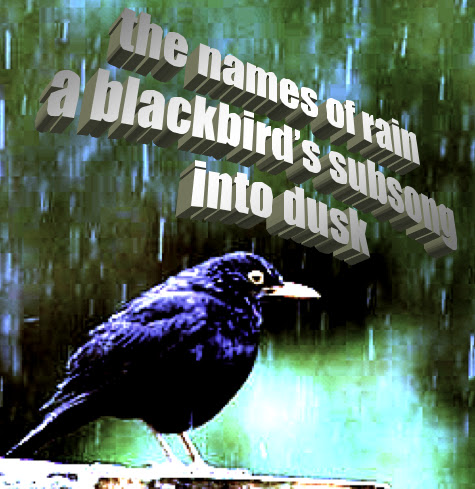
the names of rain
a blackbird’s subsong
into dusk

Publications credits: Haiku News Vol. 1 No. 35 (September 2012); featured poet at Cornell University USA (Cornell University, Mann Library haiku showcase March 2013.)

 
A Blackbird in the rain...
Al.


Alan Summers, a Japan Times award-winning writer, regularly runs online classes and workshops on haiku, and related genres such as tanka, haibun, and tanka prose.  

For further information, please don't hestitate to contact Call of the Page Course Director Karen Hoy, who will only be too delighted to send you information about these intriguing short verse poetry genres.

Karen's email: admin@callofthepage.org

.

Thursday, June 27, 2013

A selection of haiku about rain by Alan Summers (rain haiku)


a selection of haiku about rain
by Alan Summers


rain-soaked wind
the weather-worn notice
peels back more

Alan Summers
Award credit:  Judges’ favorites
Selected Haiku 
6th annual Golden Haiku Competition (The Golden Triangle Business Improvement District, Washington DC, USA) 2019


fairy wasps they exist the tension of rain 
on rain on rain 

Alan Summers
Glint ePamphlet collection by Alan Summers
Proletaria   politics philosophy phenomena  (February 2020)


the undersong of the light falling rain


Alan Summers
Half A Rainbow 
Haiku Nook: An Anthology ed. Jacob Salzer & The Nook Editorial Staff (2020)
Dedicated to Rachel Sutcliffe (1977-2019) 


I start to rain
and into falling leaves
my childhood

Alan Summers
Troutswirl - The Haiku Foundation - 
A Sense of Place: HIKING TRAIL – sight ed. KJMunro

Anthology credit: 
All the Way Home: Aging in Haiku (2019) 
ed. Robert Epstein
Middle Island Press (18 Oct. 2019)
ISBN-10: 173412542 ISBN-13: 978-1734125429


mosaic rain:
the cul de sac
of shadow

after Sylvia Plath


Alan Summers
Human/Kind Journal issue 1.6 (June 2019)
IT’S THE SMALL THINGS . . . haibun monobun

Collaborative collection:
The Comfort of Crows 
Hifsa Ashraf and Alan Summers 
(Velvet Dusk Publishing, December 2019)


nighthawks...
the sodium streets
sizzle in its rain

after Hopper


Alan Summers
Publication Credit: Weird Laburnum (September 2019)
From The After Party haiku sequence
ekphrastic haiku


backend rain…
a pair of canvas boots
framed by the door


Note: backend = autumn rain (North of England)

Alan Summers
Publication credit: Weird Laburnum ed. Michael O’Brien (August 2019)
From the haibun: Van Gogh’s combat fatigues
Published on the morning of the last day of the Tate Britain Van Gogh and British Painters exhibition

THE EY EXHIBITION VAN GOGH AND BRITAIN 27 MARCH – 11 AUGUST 2019: 


sidewalk waltz
the aroma of rain
and coffee

Alan Summers
The Haiku Foundation: A Sense of Place: CITY SIDEWALK – smell 
ed. KJMunro (December 2018)


lone crow
rain crosses
the moon

Alan Summers
ASAHI HAIKUIST NETWORK (Japan)
ed. David McMurray (June 2018)


night train
each window carries
its own little rain


Alan Summers
Brass Bell: a haiku journal (September 2017)


the scent of rain
birdsong stretches
as far as Mars


Alan Summers
Yamadera Basho Memorial Museum Selected Haiku Collection (Japan 2017)

Feature:
#AtoZBlogChallenge on Poetry Roundabout and Liz Brownlee 

A TO Z BLOG CHALLENGE 2018 S is for Haiku Poet Alan Summers, #AtoZChallenge #ZtoA 


the rain
almost a friend
this funeral 


Alan Summers
Publication credits: Azami #28 (Japan 1995); Snapshots 4 (1998); First Australian online Anthology (October 1999): Blithe Spirit article On minimalism and other things  DJ Peel Vol 9 No.3 (1999); tempslibre (2001); Cornell University, Mann Library, U.S.A. Poet of the Month (October 2001); The Omnibus Anthology, haiku and senryu  (Hub Editions Hub Haiku series 2001); Hidden (British Haiku Society Anthology 2002); The New Haiku (Snapshot Press, 2002); First Australian Haiku Anthology (2003); Birmingham Words Magazine Issue 3 (Autumn 2004); seven magazine feature: “Three lines of simple beauty”  (2006); tempslibre (2010); Blogging Along Tobacco Road: Alan Summers - Three Questions (2010); Travelogue on World Haiku Festival 2002 , Part 2  (Akita International Haiku Network 2010);  The Temple Bell Stops: Contemporary Poems of Grief, Loss and Change (Modern English Tanka Press 2012); THFhaiku app for iPhone/iPad/iPod Touch (2011); The In-Between Season (With Words Pamphlet Series 2012)

Award credit:
Highly Commended, Haiku Collection Competition, (Snapshot Press 1998)
Joint 9th Best of Issue, Snapshot Five (1999)


long hard rain my compass your true north


Alan Summers
Publication credits: Frogpond 36.1 • 2013


this small ache and all the rain too robinsong


Alan Summers
Publication credits: Modern Haiku vol. 44.1 winter/spring 2013


cabbage butterflies—
a man with an umbrella
when there's no rain


Alan Summers
Publication Credits:  Under the Basho Vol 1.1 Autumn 2013


early morning rain
the sound between
the sound


Alan Summers
Publication Credits: Asahi Shimbun (Japan 2013)


Cloud kigo
a light rain patters across
your nightingale floors


Alan Summers
Publication Credits: Asahi Shimbun (Japan 2013)

“In search of the ultimate season word to associate with clouds, Alan Summers observes how “rain writes its own story across floorboards that sing like a bird.”

David McMurray is professor of intercultural studies at The International University of Kagoshima where he lectures on international haiku. At the Graduate School he supervises students who research haiku. He is a correspondent school teacher of Haiku in English for the Asahi Culture Center in Tokyo.


the scent of rain-
I stretch the truth
into clouds

Alan Summers
Publication Credits: Blithe Spirit 23.2. 2013


blue sky rain
the sunshine leaks
from pavements


from White Dust Ghosts – a series of haiku poems by Alan Summers

Alan Summers

Publication Credits:  (Tribe issue 22,  2013)


lullaby of rain
another pinch of saffron
in the pumpkin soup

Alan Summers
Publication credits: Heron’s Nest (Volume XIV, Number 4 2012 December 2012); The Haiku Calendar 2014 (Snapshot Press, 2013)
Anthology: "The Vast Sky, An International Anthology of Contemporary Haiku"
after a quote from Sekito Kisen, "The vast sky is not hindered by the floating clouds." (2013)

Anthology credits:
naad anunaad: an anthology of contemporary international haiku ed. Shloka Shankar, Sanjuktaa Asopa, Kala Ramesh (India, 2016): https://www.amazon.co.uk/Naad-Anunaad-Kala-Ramesh/dp/9385665332/ref=sr_1_1?ie=UTF8&qid=1532036995&sr=8-1&keywords=naad+anunaad


The Wonder Code ed. Scott Mason (2017) ISBN 978-0-692-93035-9 Girasole Press
Chappaqua NY

Award Credits: 
Editors' Choices, Heron’s Nest (Volume XIV, Number 4: Dec. 2012)
Runner-up, The Haiku Calendar Competition 2013


velum clouds–
through the small hours
this writing in rain

Alan Summers
Publication credits: Haiku Novine ISSN 1451-3889 (2012)


toy suns
the winter-dark rain
smashes the city

Alan Summers
Publication credits:
Blithe Spirit (vol 23 no. 4 November 2012)
Does Fish-God Know (YTBN Press 2012) ISBN-13: 9781479211043 / ISBN-10: 1479211044


rain on the river–
when does white become
its darkest colour


Alan Summers
Publication credits: Haiku News (Vol. 1 No. 38 2012)


drifting rain 
my hundred autumn rooms 
to be alone

Alan Summers
Publication Credits: Mainichi Shimbun (Japan 2012)
Award: Best of Mainichi 2012 (Japan 2013)


does fish-god know?
rain can fall
from clear blue skies

Alan Summers
Award credit: Winner of the Blithe Spirit Cover competition for issue 22/2  (John Parsons cover artwork Autumn 2012)
https://area17.blogspot.com/2012/08/ekphrastic-haiku-alan-summers-wins.html

Publication credits: Blithe Spirit (vol 22 no. 3 2012)
Anthology: Sea Bandits ed. Aubrie Cox (2012)
Collection: Does Fish-God Know  (Yet To Be Named Free Press 2012)
https://www.amazon.com/gp/product/1479211044/ref=dbs_a_def_rwt_bibl_vppi_i0


the names of rain
a blackbird’s subsong
into dusk


Alan Summers
Publication credits: Haiku News Vol. 1 No. 35 (2012)


hard-blue sky
the ghost touch of rain
on sloe-eyed horses

Alan Summers
Publication credits: Blithe Spirit (Vol 22 No. 3 2012)


rain on the river the jesus star shifting


Alan Summers
Publication credits: Janice M Bostok Haiku Prize 2012 Anthology Evening Breeze


bouncing rain
I force the hotel window
a little wider


Alan Summers
Publication credits:
Blithe Spirit March 2012; Does Fish-God Know (YTBN Press 2012)


the drum of the rain ghosting bare hands 

Alan Summers
Publication Credits:  Under the Basho Vol 1.1 Autumn 2013


rain clouds
conversations shift around
the train carriage

Alan Summers
Publication credits: Mainichi Shimbun (Japan 2011)  
Award Credits: Honourable Mention Best of Mainichi 2011


this delicate rain
the petal makes a typo
of a gravestone date

Alan Summers
Publication credits: tinywords, haiku & other small poems ( 2011)


rain ceases
as I leave the sycamore...
one more kingfisher

Alan Summers
Publication credits: Blithe Spirit vol. 14 no. 4 (2004)


late september rain
cutting through the lane
and the mist

Alan Summers
Publication credits: in a heron’s eye  (Paper Wasp 2000)


the geraniums
flowering again
just before the rain

Note: Queensland (Australia) poem

Alan Summers
Publication credits: Potpourri Publications (USA 1994)
Collection: sundog, an australian year, (sunfast press 1997 reprinted 1998)

.