The G-force of Blue | Touching Base with Gendai haiku

Gendai:
現代
(hiragana げんだい, romaji
gendai) : the present day, modern times, today
“Through
the horrors, persecutions and travails of war, the postwar gendai movement
arose [ ] — creatively mixing ancient with contemporary aesthetics, language
and philosophy.”
What is gendai haiku to a
non-Japanese person? It didn’t
arise out of the horrors of war in Britain (or America), though we can still
suffer persecution, closed minds, fear, a cultural awakening to gross
misconduct by our pillars of society, and blunt opportunistic profiteering.
“Such
questions as how a nature poetics might deal with urban contexts, species
extinction, globalization, mechanized war — and, questions of the relevance of
haiku (if not poetry) to modernity are implicitly addressed by [ ] poets [ ]:
Hoshinaga's indigenous mytho-animistic conception of kotodama shinkô,
Tsubouchi's linguistic concept of katokoto, and Hasegawa's 'world of mind,'
[which] hopefully offer new avenues of insight for haiku, ecocriticism, and
literature as a whole.”
Both
above quotes from Gendai Haiku Project Précis: Aims by Richard Gilbert, Ph.D
Faculty of Letters, Kumamoto University, Japan http://gendaihaiku.com
Faculty of Letters, Kumamoto University, Japan http://gendaihaiku.com
The Gendai approach, I feel, is a companion to consider,
alongside the more familiar haiku we find comfort in, along with occasional
senryu.
"Kiyoko Uda has been
at the forefront of haiku's growing popularity among younger poets for the past
several decades. She recently became president of the Modern Haiku
Association--the most avant-garde of Japan's major haiku organizations.”
William J. Higginson, author, The Haiku Handbook, The Haiku Seasons, Haiku World.
William J. Higginson, author, The Haiku Handbook, The Haiku Seasons, Haiku World.
Kiyoko Uda says of gendai
haiku:
“It should be our method that we
create haiku which match the times. This is not a new idea and was prevalent in
the old days; even Sanki Saito wrote about it before the association existed.
Sanki believed: ‘To the
difficult question 'what is new?’
I will answer: the new means how
the emotions of today's society and people are expressed to fit the times. The
haiku must be innovative in any time. So we should begin and continue to
express the emotions of the people of this time and generation."
Kiyoko
Uda, President, Modern Haiku Association, Tokyo, JAPAN
(Gendai
Haiku, S.21.10) English Translation: Akiko Takazawa
敵の数だけの野菊をもち帰る
てきのかずだけののぎくをもちかえる
teki noka kazu dake no nogiku o
mochi kaeru
bringing back
wild chrysanthemum – only
the number of enemies
Uda
Kiyoko (宇多 喜代子)
Richard
Gilbert and Itô Yûki (trans.) 2007
Rough transliteration of this verse by Alan Summers
bring back as many
wild chrysanthemums
as enemies
(use only frogs)
Note:
The
Chrysanthemum Throne is the name given to the position of the Japanese Emperor;
in Imperial Japan, small arms were required to be stamped with the Imperial
Chrysanthemum, as they were considered the personal property of the Emperor;
the chrysanthemum is the seasonal flower of September; the formal surrender of
Japan in WWII (2 September 1945); and September was regularly a key month
throughout World War Two for Japan.
Many pre-Gendai haiku poets of
the New Rising Haiku movement (shinkô haiku undô), were tortured, sometimes to
death, as they didn’t support the growing Japanese corporate powers wanting to
force their country into the Second World War. Who are the enemies now, for all
of us, in time of war, both domestic and foreign? Even our internal workings
can be in conflict with what we do and cause in our external lives.
Links
The Evolution of Modern Japanese Haiku and the Haiku Persecution Incidents
Links
The Evolution of Modern Japanese Haiku and the Haiku Persecution Incidents
http://gendaihaiku.com/ito/new-rising-haiku.htm
http://www.simplyhaiku.com/SHv5n4/features/Ito.html
http://www.thehaikufoundation.org/omeka/files/original/5779bf2c255e96c09ec32bc2e055b037.pdf
http://www.simplyhaiku.com/SHv5n4/features/Ito.html
http://www.thehaikufoundation.org/omeka/files/original/5779bf2c255e96c09ec32bc2e055b037.pdf
Gendai Haiku Translations
Translated by Richard Gilbert and Itô Yûki
Forgive, but Do Not Forget: Modern Haiku and Totalitarianism
An Interview with Richard Gilbert by David F. Hoenigman
New Rising Haiku/Gendai Haiku by Melissa Allen
Innovators in English-language haiku: Gendai or not gendai...
Shinko and Gendai Haiku
Haiku — Take Five Brilliant Corners
by Richard Gilbert, Japan (scroll down)
http://www.hsa-haiku.org/frogpond/backissues/32-3-Frogpond-Fall2009.pdf
by Richard Gilbert, Japan (scroll down)
http://www.hsa-haiku.org/frogpond/backissues/32-3-Frogpond-Fall2009.pdf
The Disjunctive Dragonfly: A Study of Disjunctive Method and Definitions in Contemporary English-language Haiku
Richard Gilbert, Kumamoto University
https://www.researchgate.net/profile/Richard_Gilbert11/publication/237303353_The_Disjunctive_Dragonfly_A_Study_of_Disjunctive_Method_and_Definitions_in_Contemporary_English-language_Haiku/links/550bf87f0cf2b2450b4e32ab.pdf?origin=publication_list
Richard Gilbert, Kumamoto University
https://www.researchgate.net/profile/Richard_Gilbert11/publication/237303353_The_Disjunctive_Dragonfly_A_Study_of_Disjunctive_Method_and_Definitions_in_Contemporary_English-language_Haiku/links/550bf87f0cf2b2450b4e32ab.pdf?origin=publication_list
Saito Masaya talks with Udo Wenzel including war haiku:
http://www.chrysanthemum-haiku.net/media/Chrysanthemum%203.pdf
http://www.chrysanthemum-haiku.net/media/Chrysanthemum%203.pdf
Further Reading on Haiku (Rattle Magazine)
SURREALISM & CONTEMPORARY HAIKU
~ OR ~
SURREAL HAIKU? by Philip Rowland
SURREAL HAIKU? by Philip Rowland
Poems of Consciousness
A Review by Johnye Strickland
A Review by Johnye Strickland
Haiku's American Frontier by Paul Miller
The Haiku Universe for the 21st Century
by Modern Haiku Association
Alan Summers
I wonder if the engine of haiku is simply choosing wisely from the slew of techniques and devices available, and as any serious poet would be, mindful of each word, and of the power of poetry as a force beyond the sum of its parts. I really liked this from Richard, and to paraphrase it, or hijack it, to say that haiku poetry “opposes closure, opposes definition, opposes completeness and finality.”
GENDAI HAIKU: What Is It? Hiroaki Sato
http://modernhaiku.org/issue44-2/MH44-2-GendaiHaiku-Sato-2013.pdf
http://modernhaiku.org/issue44-2/MH44-2-GendaiHaiku-Sato-2013.pdf
Pharmakós the name you scratch
inside
Alan Summers, Does Fish-God Know (Yet To Be Named Press 2012)
Note:
This
allusive one-line haiku touches on a senior military officer’s poem after witnessing the
911 Pentagon attack. His poem is now part of the joint renga and art project
led by writers and artists such as Bob Holman and Jeff Koons.
麦よ死は黄一色と思い込む
むぎよしはきいっしょくとおもいこむ
mugi yo shi wa ki isshoku to
omoikomu
wheat –
realizing death as one color
gold
Uda
Kiyoko (宇多 喜代子)
Richard
Gilbert and Itô Yûki (trans.) October 29, 2007
corn chaff realising oil as one
colour
Alan
Summers, Does Fish-God Know (YTBN Press 2012)
I've always felt the term rapeseed for a flower was disturbing, and reminds me that in some cultures both Western and otherwise, a raped woman is not allowed to have an abortion if she so chooses. That's a vile sentence to add upon the one of complete desecration. Sadly there is no age limit to a person being raped.
field of dreams an unborn child's color isn't rapeseed
[one line haiku aka monoku]
Alan Summers
Monostich (May 2011)
Anthology credit: EarthRise Rolling Haiku Collaboration 2016 Foodcrop Haiku http://www.thehaikufoundation.org/international-haiku-poetry-day/
Collection: Does Fish-God Know (Yet To Be Named Free Press 2012):
Gendai haiku in Japan is written
by perhaps just over a third of the haiku writing population, and covers a wide
variety of subjects, and often includes kigo. Surreal gendai haiku is a parallel genre or sub-genre as
many gendai haiku are raw unforgiving social realism covering
modern/contemporary topics. Tohta Kaneko, influenced by Issa, combines the
nature of Issa with the nature of his ongoing contemporary society of post-war
Japan.
“Mr. Kaneko believed that Issa
obtained the greatest degree of sensitivity to life, what Mr. Kaneko calls “raw
perceptions of living beings.” ( ikimono kankaku).”
Part
I: The Romance of Primitivism: Tohta Kaneko’s Ikimonofûei, Notes from the Gean
13: June 2012; VIEWS, Jack Galmitz
pub.Cyberwit ISBN 978-81-8253-314-1 (2012)
死にし骨は海に捨つべし沢庵噛む
Shinishi hone wa umi ni
sutsubeshi takuan kamu
Kaneko Tohta 金子兜太
dead bones into the sea I chew
pickled radish
English
version Alan Summers
This haiku is about the horrific
aftermath of WWII Japan suffering atomic attack radiation in some parts, and
food shortages and extreme poverty across Japan. Pickled radish is very loud
when chewed, like bones being crunched, and human bones were disposed of in the
sea. Hunger, and no choice but to
dispose of so many bodies, became an unforgiving duet of death and informed
much of Kaneko’s post-war work.
Where are our dreams, where do
they go in war? While everything changes nothing changes, and the gendai
practitioners are keen to capture this disparity in our supposed civilisations
utilising any contemporary phenomenon in their path.
Where in fact does religion end
and science take over, should it, will it?
end of matins
I decode into genomes
into petals
Alan Summers, Does Fish-God Know (YTBN Press 2012)
Gendai haiku isn’t just about the
horrors of war, that may never leave some of us, or of all the cruel social
issues that abound in this world: But should we be allowed to overlook how
we’ve dragged the excesses of the 20th Century into this new
opportunity of the 21st Century?
梅咲いて庭中に青鮫が来ている
ume sai te niwajû ni aozame ga kite iru
Kaneko Tohta 金子兜太
plum blossom
blue sharks also visit
this family garden
English
version Alan Summers
Blue sharks are also Requiem
Sharks, and a Requiem is known as Mass for the dead, while the Latin also means
"rest", so perhaps the sharks are blossom viewing? The plum blossom
is associated with the start of spring, because they are some of the first
blossoms to open during the year: In the Tokyo area, they typically flower in
February and March. Dhugal Lindsay suggests the blue sharks are playful
suggestions of a weak new spring sun.
Perhaps then, blue sharks are neologistic seasonal words adding humour
to potential kigo, that many Japanese writers try out every year.
“While,
given the clear seasonal reference, it is not difficult to grasp the
sense-impression of biting cold from the Daliesque image of blue sharks in the
garden [. . .] demanding a [. . .] bold imaginative leap on
the part of the reader. Like much of the best surrealist art, it manages to be
at once powerfully disturbing and humorous.” Philip Rowland (“Surreal Haiku?” Roadrunner 9.3)
As humans, we often enjoy nature
within a park or on a ramble, or within a natural history documentary, if we
are not the actual film crew, but really many of us are unnerved by the raw
stuff invading our own personal and private spaces e.g.
Hirst's butterflies disturbing
the exhibits people
Alan
Summers, Roadrunner 12.3 (2013)
I observed people at Damien
Hirst’s exhibit at the Tate Modern become intimidated by butterflies around
them. Despite flying/floating
slowly and delicately around a constrained space of light, beautiful, harmless
and fragile, the butterflies had people spooked, visibly uncomfortable. Was the
whole purpose to make the audience an unintentional art installation, their
uneasiness on display? Are we too
removed from nature in its real state,
in an over mechanised, gadgetized cushioned world, rarely admitting to
conditions elsewhere that are contrary to a 21st Century experience?
Gendai haiku is evolving in the
West, and will inform and complement, not compete or threaten the currently
accepted haiku genre format.
We carry many memories, and I wonder if we still carry too much of our
lizard brain? The human Lizard-Brain has been evolving for around 285 million
years, and is similar in power and concept to the total brain capacity of a
modern lizard. Gendai haiku
is perhaps another way around the lizard brain still in us, and its approaches
may in time be a welcome travelling companion, alongside more familiar haiku
practices.
chestnut moon shifting in my
memory ghost floors
Alan
Summers, Roadrunner 12.3 (2013)
More about Tohta Kaneko
More about Tohta Kaneko
This article is also in memory of Shimada Seihô (1882-1944) who died from his torture treatment.
More recent gendai or experimental haiku:
depleted plutonium 消耗したプルトニウム
the creases in a photo 写真のしわ
run across a face 顔を横切る
Alan Summers
Honorable Mention,
2nd World Haiku Association Haiku Contest 2017
Main judge: Ban’ya Natsuishi WHA Home Office 3-16-11 Tsuruse-nishi, Fujimi, Saitama, Japan

an angel’s kiss birthmark a Hollyhock Blacknight sucks in its dusk
blink slowly the Jellicle cat is stealthy as a footpad
Alan Summers
From the Sōzō-mono sequence
Weird Laburnum 1st September 2020
fingers in the water trailing our dna back to its source
Alan Summers
Sublunary Review (August 2020)
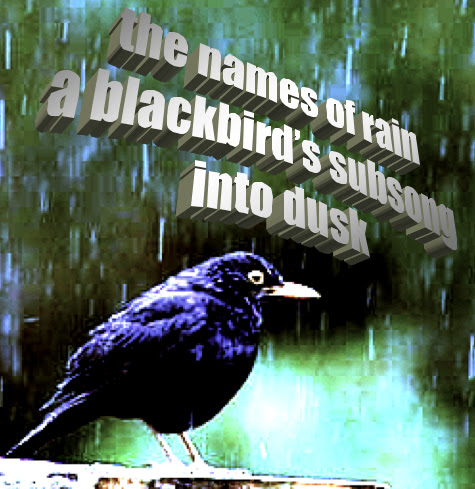
light rain & blackbird sing the distance of harm
Alan Summers
Pandemica’s Clouds sequence
behind the mask: haiku in the time of Covid-19
Singing Moon Press Pandemic Anthology ed. Margaret Dornaus
lemon-scented hospital beds how they hold our hands as blackbirds
Alan Summers
Weird Laburnum (July 1st 2020)
three haikai verses
Réka Nyitrai, author of While Dreaming Your Dreams said:
"I can envision "lemon-scented hospital beds" taught as how to write a memorable monoku."
Alan Summers
Publication credit: Blithe Spirit 26.3 haibun: Growing Pains Of The Fairy Tale Train
Anthology credit: EarthRise Rolling Haiku Collaboration 2017 Reconciliation (April 2017)
night clouds
the pull of the sound-fox
duostich
Alan Summers
Publication credit: Hedgerow #108 (March 2017)
T.V. news
the frightened room
is quiet
Alan Summers
Publication Credit: Right Hand Pointing 2017
low sky issue of winter haiku 2017
Eric Burke, Guest Editor
digital painting "low sky" D. Wisely
we shift and turn
the migrating clocks
fallen leaves
Alan Summers
Publication Credit: Right Hand Pointing 2017
low sky issue of winter haiku 2017
Eric Burke, Guest Editor
digital painting "low sky" D. Wisely
a click and clank the kitchen awake and demanding
Alan Summers
Collection: Forbidden Syllalbles (Bones Library May 2020)
she carries the warm gun’s child
Alan Summers
Publication Credit: is/let islet Scott Metz January 2017
sunflower forest
a half-human climbs
into van Gogh
Alan Summers
Publication Credit: Prune Juice : Journal of Senryu, Kyoka, Haibun & Haiga Scifaiku feature Issue 21: March, 2017 ed. Steve Hodge
sharkskin shoes
the whisper of nanobots
on his breath
Alan Summers
Publication Credit: Prune Juice : Journal of Senryu, Kyoka, Haibun & Haiga Scifaiku feature Issue 21: March, 2017 ed. Steve Hodge

Information about my own book of gendai style haiku is available:
http://area17.blogspot.co.uk/2012/10/does-fish-god-know-haiku-collection-by.html

See also:
The Pig and the Boar: The Limits to Brevity and Simplicity in Haiku by Clayton Beach
Richard Gilbert's response can be read here:
otata 34 October, 2018
Supplement
Clayton BeachThe Pig and the Boar, or: The Limits to Brevity and Simplicity in Haiku page 105
Richard Gilbert
Pig & Boar, in the Haiku Wild: An Appreciation page 131
 |
| www.callofthepage.org |
Check out our group online haiku courses for updates:
And one-to-one correspondence with or without Skype etc...
For enquiries:
For the newsletter: